Over millions of years, human body size has undergone significant changes, largely driven by shifting climates, according to a comprehensive new study. Notably, brain size evolution appears unaffected by temperature fluctuations.
Researchers from the University of Cambridge (UK) and the University of Tübingen (Germany) examined the Homo genus, including Homo sapiens. They analyzed more than 300 fossils for body and brain size data, publishing their findings in Nature Communications on July 8, 2021.
By correlating fossil data with reconstructions of ancient climates across Earth's regions over millions of years, the team identified temperature as a key driver of body size evolution. Colder climates favored larger bodies, while hotter environments led to smaller statures.
Lead researcher Andrea Manica, an expert in evolutionary ecology, notes that current climate change is unlikely to impact human body size in the near term, as the observed adaptations occurred over thousands to tens of thousands of years.
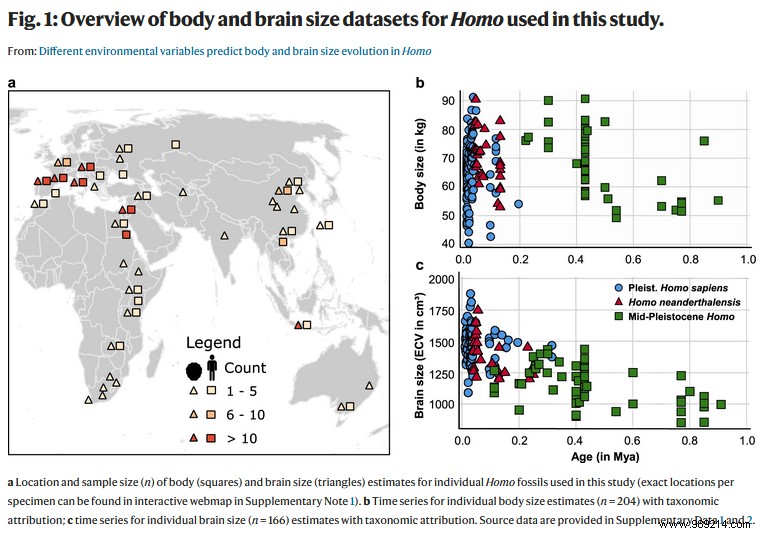
The study also explored brain size and environmental links. While Homo sapiens brains are three times larger than those of Homo habilis and earlier species, this growth shows no correlation with temperature changes. Body and brain evolution faced distinct constraints.
Interestingly, larger brains correlated with more stable environments, likely due to the high energy demands of brain maintenance requiring consistent resources.
Though global warming hasn't yet altered human morphology, other species are adapting—North American migratory birds, snakes, and turtles are shrinking in response to rising temperatures.
