Researchers have unveiled a revolutionary camera the size of a large grain of salt. Unlike prior miniature systems that produce blurry, distorted images with narrow fields of view, this innovation delivers sharp, full-color vision—ideal for detecting health issues within the body.
Cameras power diverse fields like medical imaging, smartphones, security, robotics, and autonomous vehicles. Miniaturized imagers unlock potential in nanorobotics and in vivo imaging.
Submicron pixel sensors exist, but conventional optics limit progress. Lenses must be bulky for adequate resolution, and shortening focal lengths worsens chromatic aberrations.
To overcome this, experts are pioneering metasurface optics designed via computing.
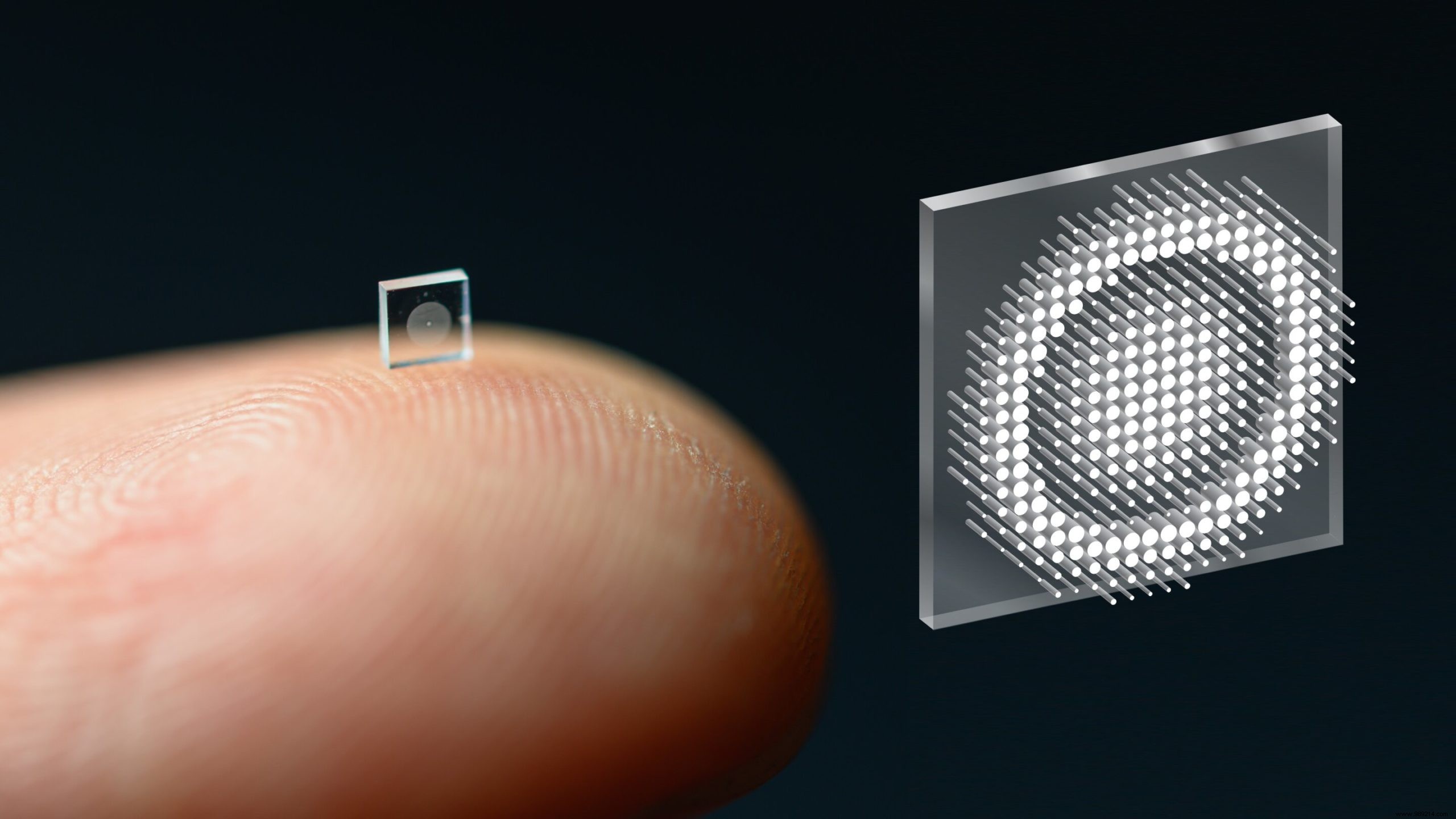
Traditional cameras rely on curved glass or plastic lenses to focus light. This system uses a half-millimeter-wide structure, fabricated like a computer chip, featuring 1.6 million microscopic pillars—each roughly HIV-sized.
These nanostructures act as optical antennas with precise geometries. Machine learning algorithms process the data to form high-fidelity images.
A Princeton University and University of Washington team advanced this technology, creating an ultra-compact camera matching a large grain of salt. Published in Nature, it produces sharp, full-color images rivaling lenses 500,000 times larger by volume.
The breakthrough integrates metasurface design with optimized computational algorithms, enabling top performance in natural light—unlike earlier versions needing lab lasers or controlled conditions.
These cameras promise nearly non-invasive endoscopies for diagnosing conditions. Arrays of thousands could map entire scenes inside the body with unprecedented detail.
Built on silicon nitride—a glass-like material suited to chip manufacturing—these devices can be mass-produced affordably.
