MIT researchers have pioneered a breakthrough in medical imaging: the first laser-generated ultrasound images of human tissues. This contact-free technique promises safer diagnostics for sensitive patients.
Traditional ultrasound relies on a handheld probe to emit and receive sound waves, enabling non-invasive views inside the body. While routine for many, it can be uncomfortable—or even painful—for patients with burns, sensitive skin, or newborns.
In a study published December 19, 2019, MIT senior research scientist Brian W. Anthony and his team introduced laser ultrasound. By using lasers to generate and detect waves remotely, this method eliminates physical contact entirely.
“We are only at the beginning of what we could do with laser ultrasound. Imagine getting to a point where we can do everything ultrasound can do now, but from a distance. It gives you a whole new way to see organs inside the body and determine deep tissue properties, without coming into contact with the patient." — Brian W. Anthony, lead author.
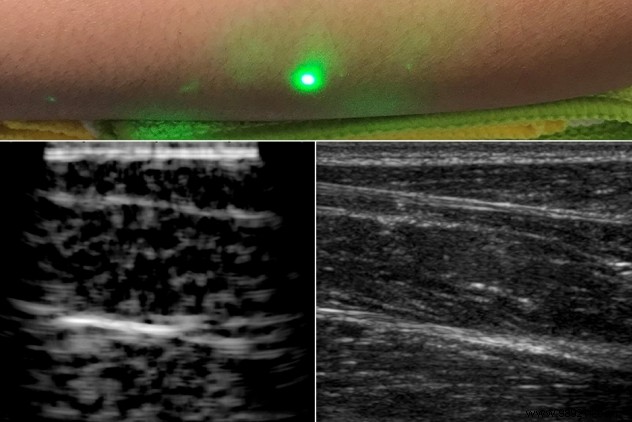
A pulsed laser at 1550 nanometers—safely absorbed by water in tissues—briefly heats the skin, creating expansion and ultrasound waves that travel through the body. A second continuous laser detects these waves via frequency shifts in reflected light, producing clear images.
This approach is highly promising for refined tissue detection. The team is now focused on enhancing resolution and miniaturizing the system into a portable device, potentially bringing advanced imaging to homes and clinics.
Related Articles:
