Nearly half of France's population has blood type O, making it the most common and highly sought-after for donations—the direct opposite of rare AB, especially AB+.
Blood groups are classified as A, B, AB, and O, each further divided by Rh factor (positive or negative). This system originated in the early 20th century with the discovery of antigens—specific substances on red blood cells targeted by antibodies.
O- blood is the gold standard for donations, earning its title as the universal donor. Lacking A or B antigens, it’s compatible with all other blood types, regardless of Rh factor. This makes O- invaluable in emergencies, while research continues toward synthetic universal blood.
O+ is next in demand, compatible with O+, A+, B+, and AB+ recipients. It’s especially vital since 85% of French people are Rh-positive. B- follows, usable for B+, B-, AB+, and AB-, while A- works for A+, A-, AB+, and AB-.
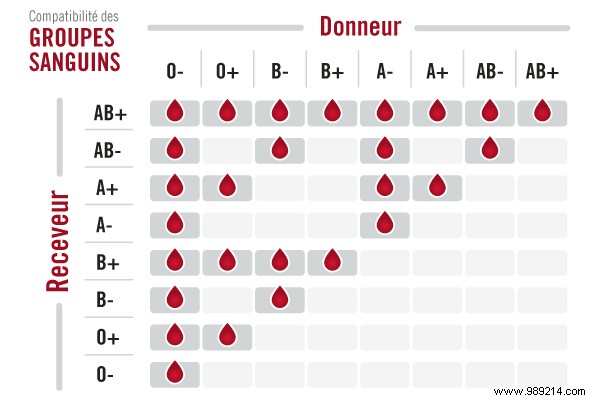
Other types have narrower compatibility. AB-, A+, and B+ donors serve only their own group and AB+. The least versatile for giving? AB+, limited to fellow AB+ recipients.
Ironically, AB+ is the universal recipient, accepting blood from any type. O-, the top donor, can only receive from other O- donors.
A rare exception is the Bombay phenotype (hh group), prevalent in India. Neither A, B, AB, nor O, it’s compatible only with itself.
