Researchers at the University of Leeds have developed a groundbreaking soft robot designed to traverse the lungs' smallest airways, enabling precise detection of lung cancer—a major advancement in diagnostic technology.
Bronchoscopy allows direct visualization of the larynx and respiratory tract, but a study in the journal Soft Robotics from University of Leeds experts reveals significant improvements. Their soft robot navigates patient lungs effectively, promising to revolutionize lung cancer diagnosis—the world's second most common cancer in men and third in women. This innovation accesses the entire bronchial tree, including its tiniest branches.
Traditional bronchoscopes, used under local anesthesia, detect lesions and enable biopsies via a flexible tube (3.5-4 mm diameter) inserted through the mouth or nose. However, these rigid tools can't reach smaller branches without a thinner catheter, a maneuver that's technically challenging.
To overcome bronchoscope limitations, Leeds researchers created a soft, articulated robot tube—flexible, compact, and fully autonomous. Composed of two interconnected cylindrical segments (each 2 mm in diameter and 80 mm long) made from elastomeric material embedded with magnetic particles, it moves via external magnetic fields from robotic arms outside the body.
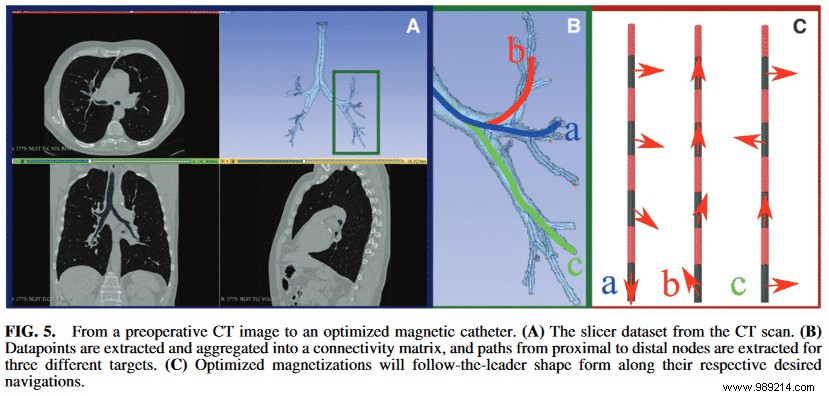
The robot's path is pre-programmed using preoperative lung scans, ensuring accurate navigation. While initial tests succeeded on a bronchial tree replica, clinical adoption will require further validation.
