University of California researchers have successfully transferred the camouflage ability of opalescent squid into human cells, rendering them nearly transparent—a scientific first.
The quest for invisibility has long captivated philosophers and science fiction writers. Today, cutting-edge science is turning this concept into reality. Recent advancements include materials that bend light around objects, creating an "invisibility cloak" with potential military applications.
Building on this, a study published in Nature Communications by experts at the University of California draws inspiration from cephalopods.
Active camouflage is a key survival tactic for octopuses, squids, and cuttlefish. This research focused on the coastal opalescent squid (Doryteuthis opalescens).
Female squid can alter a brown band on their mantle to appear fully transparent or opaque white when evading predators. They achieve this through specialized leucophore cells containing reflectin proteins, which rearrange to manipulate light reflection and blend seamlessly with their environment.
Using genetic engineering, the team introduced reflectin proteins into the cytoplasm of human embryonic kidney cells. Under microscope observation in Petri dishes, these cells exhibited the same light-scattering properties as squid cells, confirming the transferability of this cephalopod trait across species.
“Through quantitative phase microscopy, we confirmed that the protein structures displayed distinct optical properties from the surrounding cytoplasm,” the researchers noted. “In essence, they functioned optically much like in the squid.”
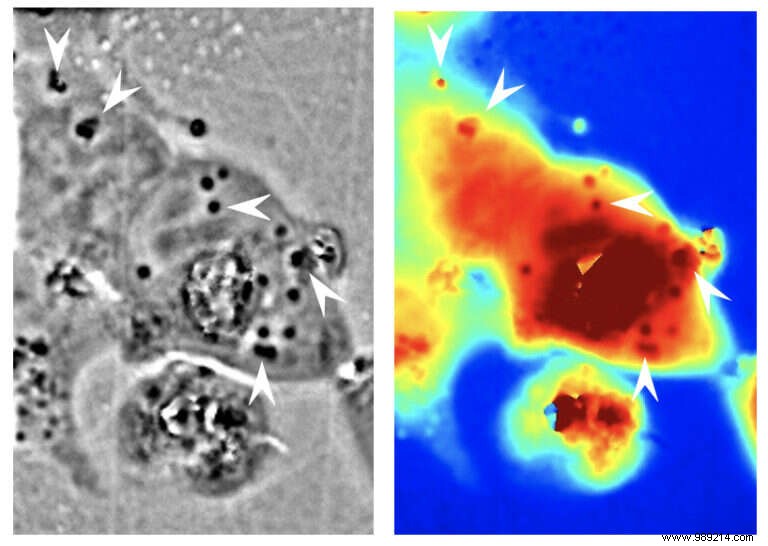
The team further tested tunability by exposing cells to varying sodium chloride concentrations. Higher levels increased light scattering, making cells more prominent, while lower levels enhanced transparency. Cells without reflectins showed no such response.
“Our findings demonstrate a novel method for modulating light-scattering properties in human cells,” the researchers concluded.
Source
