In Russia, a team of expert neuroscientists has successfully implanted a neural chip into the brain of a blind baboon. This milestone is part of the ELVIS program, aimed at restoring sight to blind individuals.
Brain implants are revolutionizing neuroscience. For instance, in December 2021, Elon Musk announced Neuralink's plans for human trials starting in 2022, focusing on wireless brain-machine interfaces to control devices like computers and prosthetics, while addressing conditions such as Parkinson's disease.
On January 25, 2022, Russia's Sensor-Tech Lab shared on Facebook that neurosurgeons had successfully implanted a neural chip in a blind baboon to restore its vision. This work falls under the ELVIS (ELectronic VISion) program, which seeks to enable sight for those blind from birth or who have lost it.
Eligible participants must be aged 24-65 with fully intact cognitive abilities.
The implant, positioned in the brain, uses a camera to capture object contours and transmit electrical signals via sensors, providing partial vision restoration. Researchers aim to progressively enhance image quality to near-natural levels. As illustrated below, the camera is mounted on a removable headband.
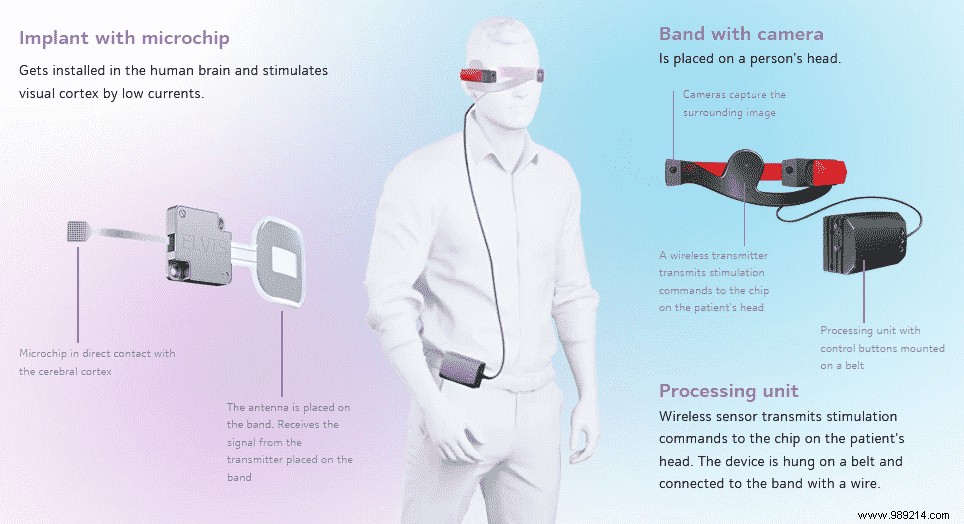
The baboon implantation marks a key success. Next, scientists plan around a dozen additional tests to assess if the animal can recognize geometric shapes by fitting objects into matching slots, similar to children's shape-sorter toys. This evaluates neural adaptation.
Successful outcomes will pave the way for human clinical trials in 2024, with commercial availability targeted for 2030 at approximately $70,000 per device. The Russian government plans subsidies to improve accessibility.
