Mucus traps pathogenic microbes as a vital part of our body's natural defenses. Researchers at MIT have successfully replicated its intricate structure, potentially paving the way for innovative treatments against infectious diseases.
Mucus comprises various viscous, translucent secretions that line the nose, other external orifices, and the digestive and urinary tracts. It shields these organs from bacterial infections and viruses. Composed primarily of mucins—large proteins rich in glycans—mucus effectively halts bacteria by preventing toxin secretion, cell adhesion, and intercellular communication. Glycans are polymers of monosaccharides (sugars).
In a study published in ACS Central Science on March 30, 2021, MIT researchers highlight mucus as a powerful tool against multi-drug-resistant bacteria. Unlike antibiotics, which kill bacteria and often lead to resistance—a major public health crisis per the WHO—mucins simply neutralize bacteria without promoting resistance.
Replicating mucus is no simple task, but the team achieved it using a polymer backbone via Ring-Opening Metathesis Polymerization (ROMP), a technique developed in the 1970s and widely used in chemical and pharmaceutical industries. ROMP opens cyclic carbon structures to create linear molecules with carbon-carbon double bonds, which then form extended polymers.
ROMP relies on metal catalysts to control molecular configuration—"cis" or "trans"—with the elongated cis form most closely mimicking natural mucins. Testing on Vibrio cholerae, the cholera-causing bacterium (see image below), showed cis polymers were more effective and water-soluble, suggesting applications in eye drops and skin moisturizers.
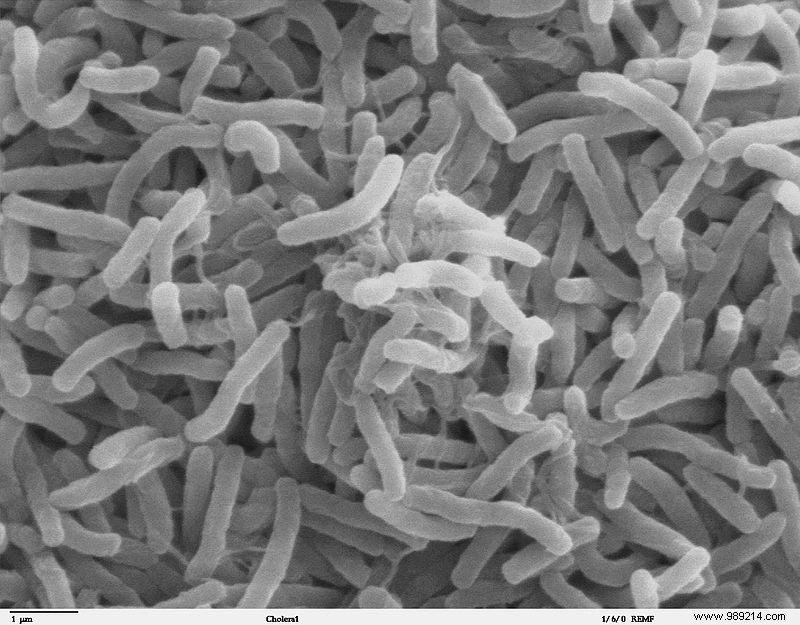
The team is now exploring optimal glycan integrations, as mucus can contain hundreds of variants, each targeting specific bacteria—a complex but promising challenge.
