A man silenced by a stroke since 2003 after a devastating car accident can now produce understandable words and sentences using only his thoughts. U.S. researchers have developed an implant that taps into his brain's speech centers, as detailed in a groundbreaking study in the New England Journal of Medicine.
Featured in The Times, the story highlights a man voiceless since 2003 who recently regained communication through a screen. Researchers surgically implanted 128 electrodes into the brain regions responsible for language production. The device captures neural signals from the sensory and motor processes controlling the lips, jaw, tongue, and larynx.
Over time, the implant was linked to a computer. Known as "Pancho," the patient practiced forming simple phrases. A custom AI algorithm decoded the electrode signals, initially recognizing individual words and gradually progressing to full phrases.
"The word recognition is a life-changing experience," Pancho told The Times. "Not being able to communicate with anyone, have a normal conversation, or express yourself in any way is devastating—it's very hard to live like this." During a training session, he added: "It really is like having a second chance to speak again."
"Our system translates brain activity that would normally control his vocal apparatus directly into words and sentences," explained David Moses, a key team member. Dr. Edward Chang, who led the research, noted: "Maybe that part of his brain was dormant. We just didn't know if it would ever wake up so he could talk again."
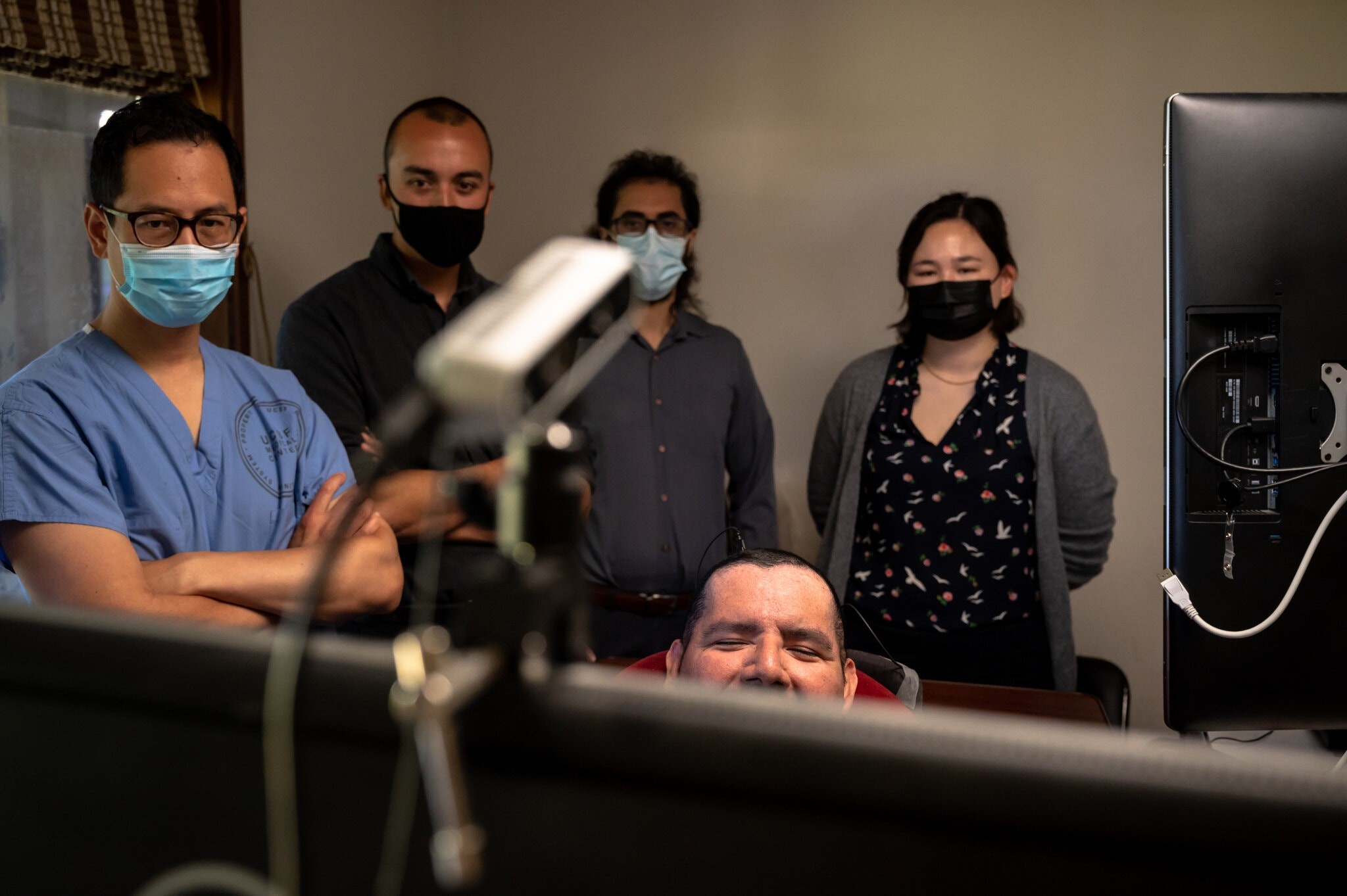
Previously limited to five words per minute using a mouse controlled by head movements, Pancho now communicates at 15 to 18 words per minute. Researchers believe faster decoding is achievable, aiming for the typical conversational speed of about 150 words per minute.
This speech neuroprosthesis represents a major advance for the tens of thousands unable to speak due to intact neural pathways blocked by paralysis. In the future, it could benefit those with brain injuries, amyotrophic lateral sclerosis (ALS), or cerebral palsy who lack the muscle control for speech.
