At Hôpital de la Timone in Marseille, surgeons Louis Hoffart and Laurent Guyot are pioneering a remarkable surgery called Osteo-Odonto-Keratoprosthesis (OOKP), using a patient's own tooth to create an ocular prosthesis and restore vision for select blind patients.
Beyond total blindness, around 10 million people worldwide live with degenerative eye conditions like age-related macular degeneration (AMD) or macular dystrophy. Regaining sight remains a profound hope for those affected. Ongoing research includes innovations like the 2016 University of Melbourne technique, which transplants lab-grown corneal cells via hydrogel film.
Drs. Hoffart and Guyot are France's only practitioners of OOKP, a technique first developed in the 1960s by Italian ophthalmologist Benedetto Strampelli (1904-1987). In Belgium, 11 patients underwent the procedure, with eight regaining their sight.
The process selects a healthy patient tooth as the support for an optical implant. An optical cylinder is embedded into the tooth, which is then placed in the cheek for four months to integrate with tissues and blood vessels. Finally, the prepared tooth-implant is positioned directly into the eye socket.
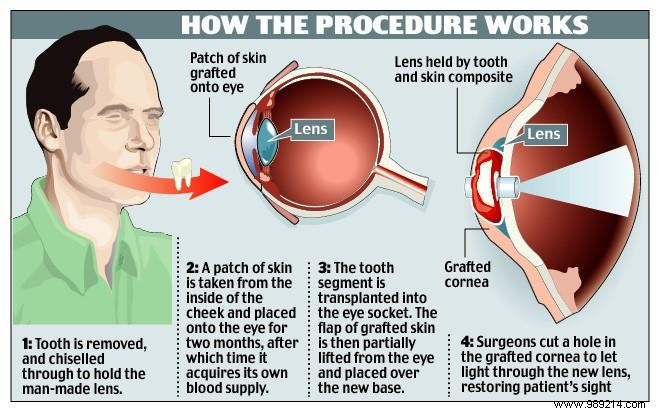
Eligibility for OOKP is strict: patients must be blind in both eyes, have exhausted conventional treatments, and show viable optic nerves and retinas capable of transmitting visual signals to the brain. It's a true last-chance operation, with low rejection rates, though it costs about 30,000 euros and is reserved for high-success cases.
If the eye detects no light, the implant won't help. Amid advancing retinal implant research, OOKP stands out as a pioneering, still-effective technique—rare but reliable.
