A team of Italian surgeons has pioneered invasive telesurgery 15 kilometers away, leveraging ultrafast 5G connectivity. This groundbreaking case, detailed in the prestigious Annals of Internal Medicine published this Monday, showcases the future of remote medical procedures.
Telesurgery isn't entirely new. The first successful operation occurred nearly two decades ago on September 7, 2001, when a 78-year-old patient in Strasbourg had her gallbladder removed. The surgical team was 7,000 kilometers away in New York.
Surgeons directed a robotic system on-site, connected via dedicated high-speed optical fiber that transmitted data in less than 200 milliseconds.
This milestone opened doors to transformative applications, such as delivering expert care in underserved areas or tackling highly complex procedures.
While subsequent telesurgeries have occurred, progress stalled due to limitations in network speeds—until 5G emerged as a game-changer.
In this latest study, Italian experts conducted vocal cord surgery remotely over 15 km using a 5G network.
Local assistants prepared a cadaver and configured the remote tools. Surgeons then alternated control, using robotic forceps and lasers on the vocal cords.
They relied on virtual reality glasses, a tablet, and haptic feedback devices to manipulate the robots with precision.
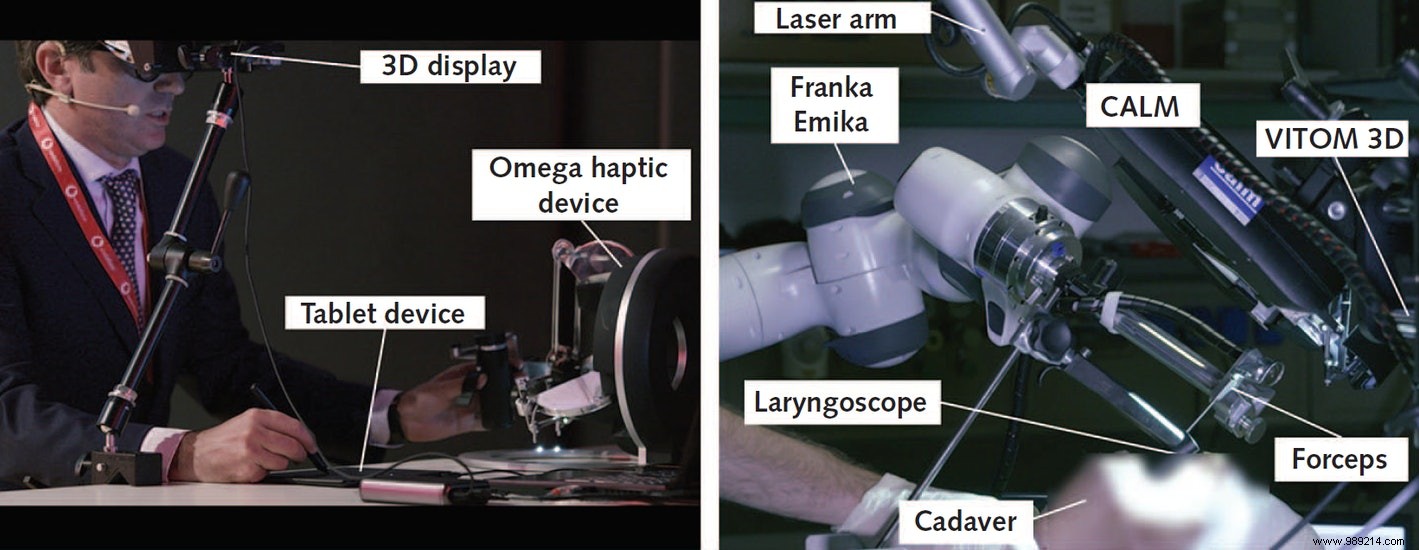
Leonardo Mattos, head of the biomedical robotics lab at the Italian Institute of Technology, described profound immersion despite the distance.
“The surgeons felt like they were right in the room,” he said. “Robotic tools reduced stress during delicate maneuvers by providing exceptional stability and fluid motion, enabling greater precision and confidence.”
The procedure succeeded, with surgeons experiencing a maximum lag of 280 milliseconds between commands and actions. Though focused on vocal cords, Mattos sees broad potential.
“This tech suits other laser surgeries and can adapt to various robotic procedures,” he noted. “Any robotically feasible surgery today can likely become telesurgery.”
As a proof-of-concept using a cadaver, widespread adoption will take years. Technical hurdles are surmountable soon, but legal and ethical challenges may pose longer-term obstacles, per the researchers.
