American artist and technologist Justin Blinder has developed a novel malware called Pandemic Pulse. It infects computers based on COVID-19 infection and death rates in their geographic location, offering a unique way to experience the pandemic's effects firsthand.
Justin Blinder, an artist, technologist, and researcher, designed Pandemic Pulse to mirror local COVID-19 infections and deaths by throttling computer performance accordingly. First showcased in late 2020 (see video at article's end), the project resurfaced amid the Delta variant's rise. Blinder aimed to make staggering epidemic statistics more relatable through this immersive visualization.
Drawing data from the U.S. Centers for Disease Control and Prevention (CDC), the malware is tailored to American locales and won't function in France or elsewhere. Performance impacts vary widely by region, reflecting real local differences.
“The app recontextualizes relevant epidemiological data about the pandemic and attempts to make it tangible and relevant on a personal level,” Blinder explains on his site.
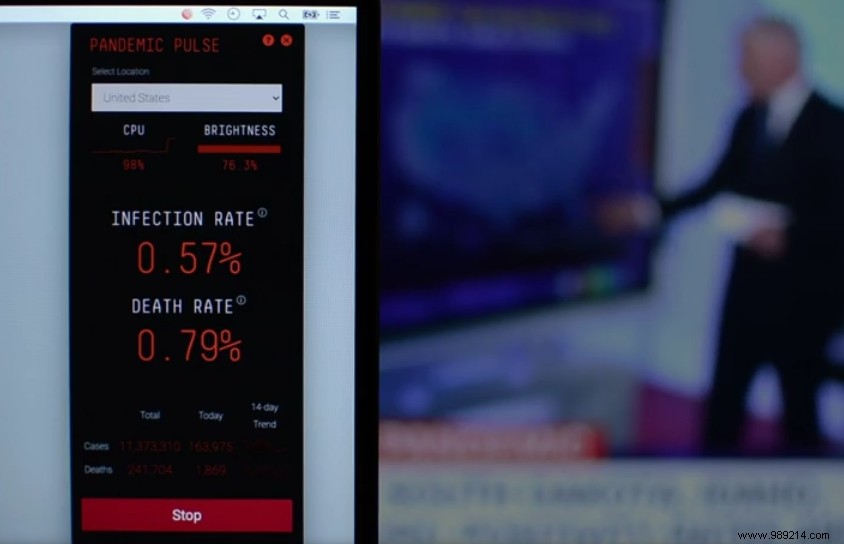
Users become active participants, with their devices reflecting the local health situation. Technically, the malware reduces CPU speed based on infection rates and dims screen brightness according to death rates.
“Feeding off our computers, the malware thrives on the same platform we use to track news of COVID-19 and its impacts. This time, through our devices, we can feel specific effects of its omnipresence: a certain slowness (computing) and a dimming (of the screen),” Blinder notes.
Though classified as malware, Pandemic Pulse involves only willing volunteers. Blinder never targeted unsuspecting users. Participants can deactivate it with one click, and the open-source code is available on GitHub for transparency.
