In early February 2021, a Sahara dust cloud swept across France, carrying traces of Cesium-137 from France's nuclear tests in Algeria during the early 1960s. Researchers, including radiation protection expert Pierre Barbey, confirmed the presence of this artificial radioactive isotope, often associated with nuclear events like Chernobyl in 1986.
On February 6, 2021, the dust cloud blanketed France. As reported by France 3 Régions, Pierre Barbey, a radiation protection specialist at the University of Caen and advisor to the Association for the Control of Radioactivity in the West (ACRO), collected a sample from his car windshield near Chapelle des Bois in the Jura Mountains (Doubs department). His analysis clearly detected Cesium-137.
"This artificial radioelement is not naturally occurring in sand and results from nuclear fission during explosions," Barbey explained.
The deposition measured 80,000 Bq (becquerels) of Cesium-137 per km². While memories of Chernobyl (1986) and Fukushima (2011) may evoke concern, this level poses no health threat. Cesium-137 has a 30-year half-life, halving its radioactivity every 30 years. After seven such cycles, only 1% remains.
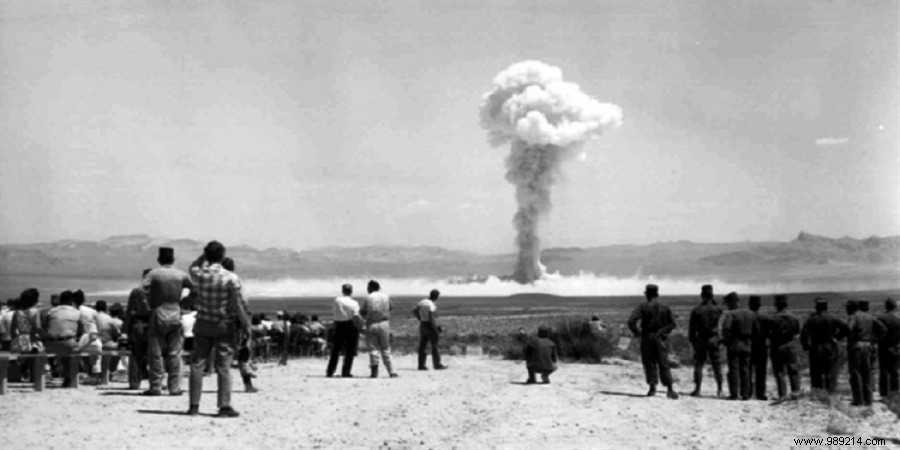
ACRO's study aimed not to highlight danger—researchers confirmed none existed—but to underscore France's nuclear testing abroad. Populations in affected areas still live amid lingering Cesium-137 contamination. From 1960 to 1966, France conducted 17 atmospheric tests in southern Algeria, then a French territory.
The first, codenamed Blue Jerboa on February 13, 1960, yielded 70 kilotons—three to four times the power of the Hiroshima bomb dropped by the U.S. in 1945.
Post-Evian Accords (March 1962), tests continued in the Sahara until July 1967, shifting to Polynesia's Moruroa Atoll starting in 1966. President Jacques Chirac declared the end of French nuclear tests in 1996.
