World Health Organization (WHO) data indicates the Asian flu pandemic of 1956-1958 claimed 1 to 4 million lives globally. In France, recent claims suggest around 100,000 deaths, though no verified sources confirm this figure.
With over 260,000 deaths recorded to date, COVID-19 marks the first major global pandemic of the 21st century. Yet the 20th century saw several devastating outbreaks, including the 1918-1919 Spanish flu, which killed 40-50 million people. More recently, the 1968-1970 Hong Kong flu caused about 1 million deaths—but do not confuse it with the earlier Asian flu of 1956-1958.
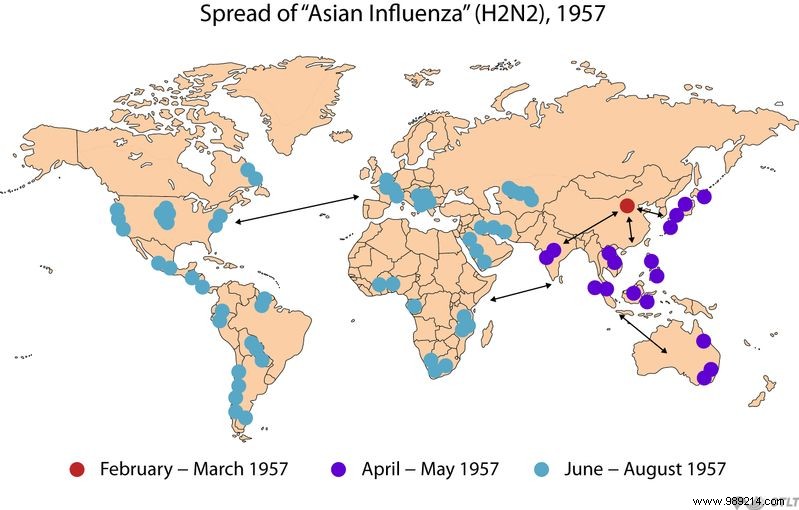
The epidemic emerged in China's Guizhou and Yunnan provinces in late 1956 or early 1957. British, Australian, and American labs soon identified the novel H2N2 influenza virus. Though global flu surveillance was limited then, this was the first pandemic tracked in real time by virology experts.
By February 1957, it hit Singapore; April brought it to Hong Kong, infecting 250,000 rapidly. June saw U.S. cases, and Europe followed in August. Within six months, the virus circled the globe via land and sea. The WHO estimates 1 to 4 million deaths.
A March 22, 2020, CheckNews (Libération) article addressed claims of 100,000 French deaths from the 1957-1958 Asian flu. While drawing parallels to COVID-19, it noted the origin of this figure is unclear, despite citations by scientists in recent years.
Official data exists: Demographer Roland Pressat's 1960 report on France's demographics tallied just over 15,000 flu deaths (11,899 in 1957; 3,270 in 1958). He acknowledged potential undercounting due to flu-related death reporting gaps, suggesting perhaps tens of thousands more. Still, evidence for 100,000 remains elusive.
The WHO's wide range—1 to 4 million—reflects era challenges: Many nations struggled to accurately diagnose and tally flu deaths.
