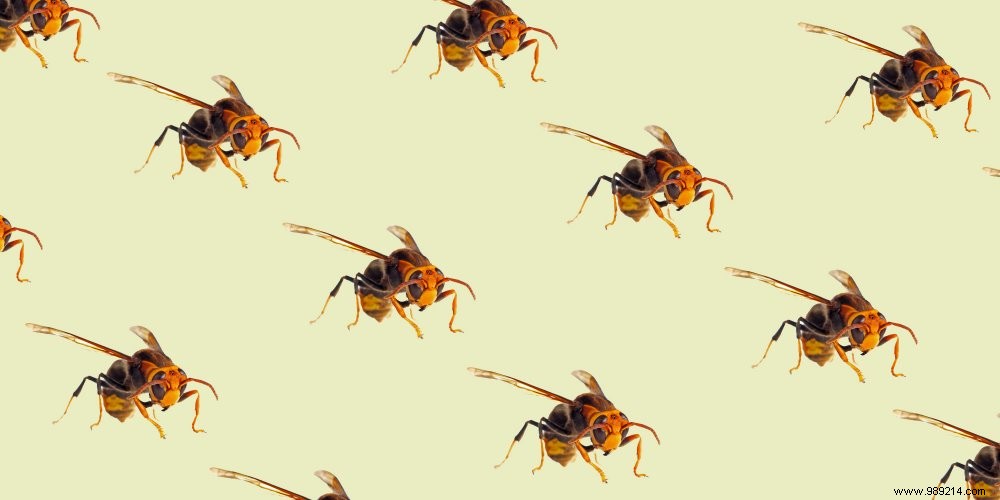
 Originating from China, the Asian hornet has colonized much of France. Highly aggressive toward bees, it rarely attacks humans unless provoked. Keep your distance—its stings cause intense pain and pose risks for those with sensitivities.
 The Asian hornet stands out with its yellow legs and dark body featuring a wide orange band. Similar in size to the European hornet (1.7 to 3.2 cm), it inflicts major damage on orchards and apiaries. In urban areas, 80% of its diet comprises bees, which it ambushes and decapitates as they return laden with nectar.
Vespa velutina, its scientific name, also preys on butterflies, flies, dragonflies, and spiders. It avoids humans but can turn aggressive if startled or if you approach its nest.
Introduced to southwestern France in 2004 via imported Chinese pottery, this exotic species adapted rapidly and proliferated. Today, it's established nationwide and spreading to Spain, Portugal, Italy, Belgium, Germany, and England—including the Paris region. Data from the Fredon Île-de-France association, experts in surveillance and pest management, shows nests reported and destroyed rising from 31 in 2014 to 2,353 in 2018.
Nests, often high in trees or attics, are challenging to remove. Never attempt removal yourself—within 4-5 meters, you risk enraging the colony and multiple stings. Contact professionals or your local town hall; many municipalities fund nest destruction.
Video of the day:Generally non-aggressive, the Asian hornet stings when disturbed. Unlike bees, it can sting repeatedly, even penetrating rubber boots. Pain is sharp and intense. First, remove constricting items (belts, jewelry, watches) and extract the stinger intact with tweezers. Use a venom extractor pump to draw out poison, then disinfect.
To ease pain and swelling, apply cold immediately (ice pack or cold spray like Urgo).
Allergic individuals, those with weakened immunity, young children, and seniors should seek medical help promptly. Be cautious with stings to the neck or mouth, as angioedema may develop. Though its venom isn't more potent than that of wasps or European hornets, fatalities occur annually.
Local reactions like redness, swelling, or itching are common and typically mild. However, seek emergency care (dial 18 or visit ER) for vomiting, severe headache, breathing issues, or convulsions.
Severe risks include sudden blood pressure drops or anaphylactic shock—a life-threatening allergic response—especially from multiple stings or in those sensitive to Hymenoptera venoms. Rapid adrenaline injection is essential.
Read also: