Using induced pluripotent stem cells, researchers have cultivated brain organoids in the lab that form rudimentary eye structures capable of detecting light and transmitting signals to the brain. The groundbreaking study is published in Cell Stem Cell.
The human brain remains one of nature's most intricate structures, and scientists are still unraveling its mysteries. To advance our understanding, researchers create miniature, lab-grown versions of the brain. The process starts with skin cells from donors, reprogrammed into induced pluripotent stem cells capable of differentiating into any cell type. These are then cultured in an environment mimicking early brain development, prompting the formation of diverse brain cells.
When successful, this yields a pea-sized, three-dimensional brain model. Experts use these organoids to investigate brain development, disease responses, and drug effects with unprecedented precision.
A team from University Hospital Düsseldorf in Germany has pushed boundaries further, engineering brain organoids that spontaneously develop optic sections—vision structures where the optic nerve meets the retina.
Drawing on stem cells from four donors, they generated 314 brain organoids across 16 batches. Notably, about 72% formed optic cups, emerging around day 30 and maturing by day 50—mirroring timelines in human embryonic retinal development.
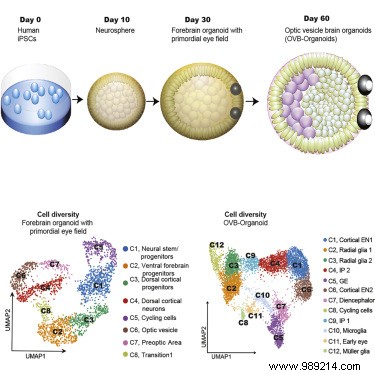
These optic cups developed symmetrically on the organoid's front surface and proved functional. Within them, diverse retinal cell types formed neural networks that respond to light stimuli and relay signals to the brain tissue. Lens and corneal tissues also emerged—a world first achieved in vitro.
“Our work highlights the remarkable self-organizing capacity of brain organoids to produce primitive, light-sensitive sensory structures akin to those in human development,” states lead researcher Jay Gopalakrishnan.
These advanced organoids hold immense promise for studying brain-eye interactions in embryonic development, modeling congenital retinal disorders, and testing novel therapies.
