The World Health Organization (WHO) has cautioned that Africa risks becoming the next COVID-19 epicenter, with up to 3.3 million potential deaths if the virus isn't contained effectively.
While Africa has so far avoided the heaviest impacts of the COVID-19 pandemic, limited resources raise serious concerns for the future. On April 17, 2020, outlets like BBC News and The Guardian reported on projections from the United Nations Economic Commission for Africa (ECA). These models forecast between 300,000 and 3.3 million deaths by the epidemic's end, with infections potentially surpassing one billion—nearly the entire continent's population.
This dire outcome assumes no preventive measures are implemented. With prompt and rigorous social distancing, the ECA projects infections could be limited to around 120 million.
Africa's first case emerged on February 14, 2020. As of then, the continent neared 20,000 confirmed cases, mainly in Algeria (2,534 cases / 367 deaths), Egypt (3,032 / 224), Morocco (2,685 / 137), and South Africa (3,034 / 52).
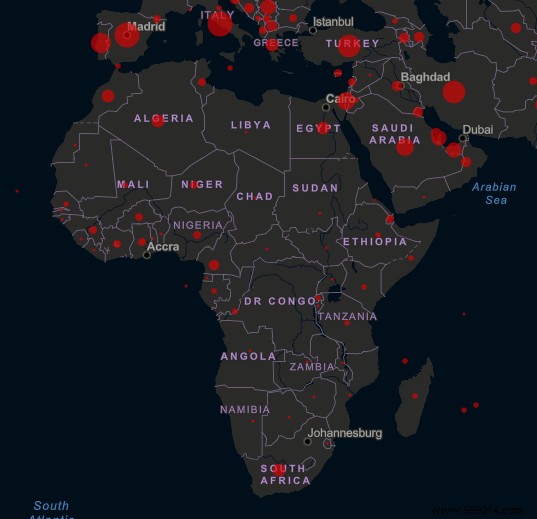
These projections draw from current data and models by Imperial College London. The WHO anticipates over 16 million infections across Africa by June 2020's end, with up to 20,000 deaths in the following ten weeks. However, experts emphasize high uncertainty in these figures.
In a best-case scenario, infections might total nearly 3 million (with 3,500 deaths) by late June. Worst-case estimates climb to 100 million infections (126,000 deaths).
Outcomes hinge on Africa's response. The WHO notes infection growth rates mirror Europe's early stages, which faced severe surges. Without action, Africa could emerge as the pandemic's new focal point.
