While nightmares disrupt nearly half of children—especially during early childhood—in their REM sleep phase, their frequency steadily declines into adulthood. Individual variations remain, but psychological growth, daily misunderstandings, and reflective processing all influence children's dreams and nightmares, playing key roles in their development.
Both nightmares and bad dreams feature disturbing images, intense negative emotions, and themes often revolving around physical or psychological threats. Unlike bad dreams, nightmares wake the sleeper, though most studies group them as "disturbing dreams."
Nightmares differ from night terrors, which occur early in the night during deep slow-wave sleep. Night terrors can start at 6 months, peaking at ages 3-4, while nightmares begin around age 2, happening later in REM sleep.
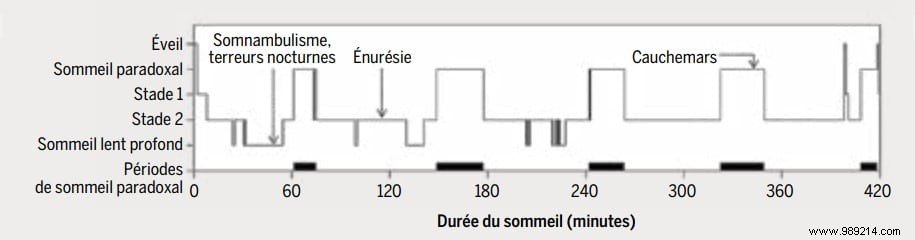
Statistics show children experience nightmares far more than adults. A Canadian study compiling prior research found 50% of 4- to 9-year-olds report nightmares, rising to 72% for bad dreams in 8.5- to 11-year-olds. Frequency generally decreases with age, though reports vary by parent vs. child self-reporting.
"In essence, a nightmare arises when the dream fails its role as protector and guardian of sleep: the scenario can't channel or neutralize the child's anxieties," explains Lyliane Nemet-Pier, a psychologist and psychoanalyst specializing in sleep disorders. "These anxieties overwhelm the child, waking them in genuine fear, as children under 3-4 struggle to distinguish reality from imagination."
Dreams and nightmares aid psychological development, helping children process frustrations and desires unconsciously. "Nightmares express our emotions—often those from the day," notes Stephan Valentin, PhD in psychology and early childhood specialist. "With psychic defenses relaxed in sleep, emotions surface more freely." Nightmares may regulate emotions and neutralize daily anxieties. Linked to language development, fewer nightmares occur as children gain words for feelings.
Children often recall nightmares more than pleasant dreams. Common themes evolve: at age 2, fears of being bitten, eaten, or attacked; ages 3-5, menacing animals; ages 6-12, threatening humans, strangers, or beasts; ages 13-16, rejection, ridicule, low self-esteem, or depression. Adults face fewer such anxieties, explaining reduced nightmares.
Children encounter more confusing events—like school, family changes (moves, divorce, new siblings), TV images, or stories—that resurface in nightmares. Ages 7-12 mark a "latency period" of curbed impulses, focused learning, and vivid imagination, potentially heightening nightmares as critical thinking develops. The child's building brain impacts dreams profoundly.
Finally, children face more rules—parental (no hitting, obey), societal (coexist, follow norms)—creating conflicts vented in nightmares, which typically fade in adulthood.
Like adults, children's nightmares link to anxiety, stress, behavior issues, and media violence. The Canadian study found strong ties between disturbing dreams and child behavior problems (shyness, anxiety, depression, social issues, attention deficits, delinquency, aggression), strongest with emotional disturbances. Another linked nightmares to academic struggles.
"In adults, nightmares strongly correlate with PTSD and trauma," note the researchers. "The same holds for children: one study of 15-year-olds post-trauma found 100% reported recurrent disturbing dreams tied to the event, even six months later."
