A peer-reviewed study in The Lancet reveals the novel coronavirus emerged weeks earlier than Chinese officials reported.
In late December 2019, China announced a mysterious virus outbreak in Wuhan. Initial reports suggested animal-to-human transmission at a seafood market, possibly from bats or snakes. However, new research published in The Lancet calls this into question.
Researchers reviewed clinical records from the first 41 confirmed 2019-nCoV patients.
Notably, more than one-third had no exposure to Wuhan's seafood market. The earliest case, also unlinked to the market, fell ill on December 1, 2019—roughly two weeks before official announcements from Chinese authorities.
This raises fresh questions about the virus's reservoir. Daniel Lucey, an infectious disease expert at Georgetown University Medical Center, suggests early cases may have been exposed elsewhere.
Further, the first reported fatality on January 9 in Wuhan infected his wife, who had not visited the market. Similarly, on January 10, five Shenzhen family members transiting through Wuhan contracted the virus without market contact, later spreading it at home.
These instances of apparent human-to-human transmission occurred nearly two weeks before Chinese authorities acknowledged it on January 20.

Such findings suggest possible delays in information sharing by Chinese officials.
“There are many internal bureaucratic processes in China before official statements emerge,” notes Alexandra Phelan of Georgetown's Center for Global Health Science and Security. “This can slow information release significantly.”
“The discrepancies with China's initial account heighten concerns over data reliability,” says Steven Hoffman, director of the Global Strategy Lab. “Withholding information intentionally would harm public health and violate international law.”
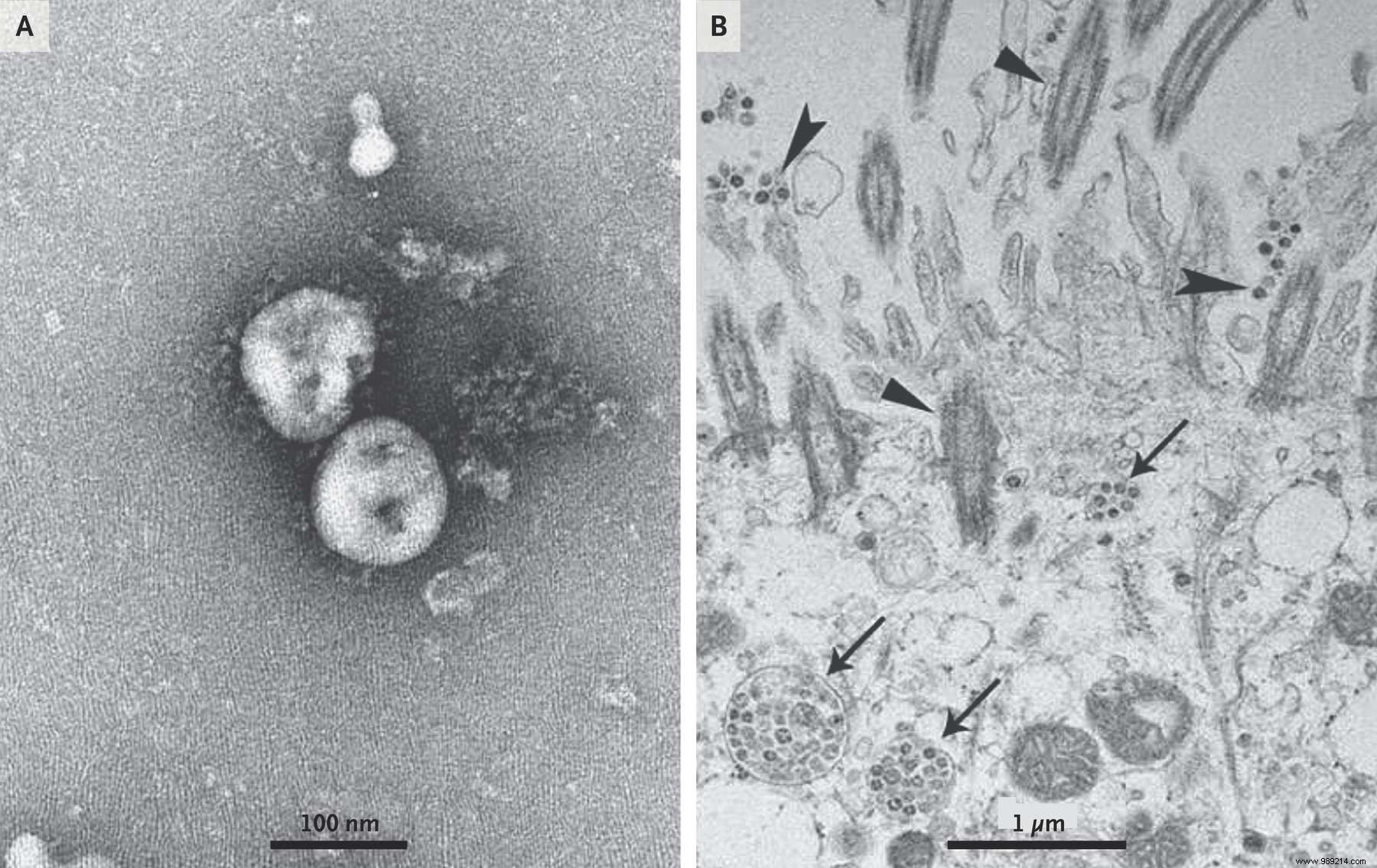
Genetic sequencing confirmed the virus belongs to the Coronaviridae family. Now, researchers have captured its first electron microscope images, published in The New England Journal of Medicine.
The left image shows free 2019-nCoV particles via negative staining. The right depicts viral particles (60-140 nm in diameter) in infected respiratory epithelial cells.
No vaccine exists yet for 2019-nCoV, but the Coalition for Epidemic Preparedness Innovations (CEPI) has launched three partnerships for treatments: Inovio Pharmaceuticals (US), University of Queensland (Australia), and Moderna (US, with the National Institute of Allergy and Infectious Diseases).
Source
Related Articles:
