Researchers from the University of Southampton in the UK have modeled the potential global spread of the 2019-nCoV coronavirus, focusing on population movements during Chinese New Year. Their analysis ranks the 30 cities outside China most vulnerable over the next three months.
Recently, we highlighted the Canadian startup BlueDot, which used AI to issue early warnings about the emerging coronavirus to institutions in Canada, the US, and public health officials in over a dozen countries.
BlueDot partnered with the University of Southampton on this study, published January 25, 2020 (PDF report, 20 pages). The model incorporates population flows tied to Chinese New Year and accounts for Wuhan's quarantine travel restrictions.
Drawing on thousands of anonymized cell phone locations and IP addresses from 2013-2015, plus 2018 international flight data, the study ranks cities by inbound travelers from 18 high-risk Chinese cities. The timeframe spans two weeks before Chinese New Year to two-and-a-half months after.
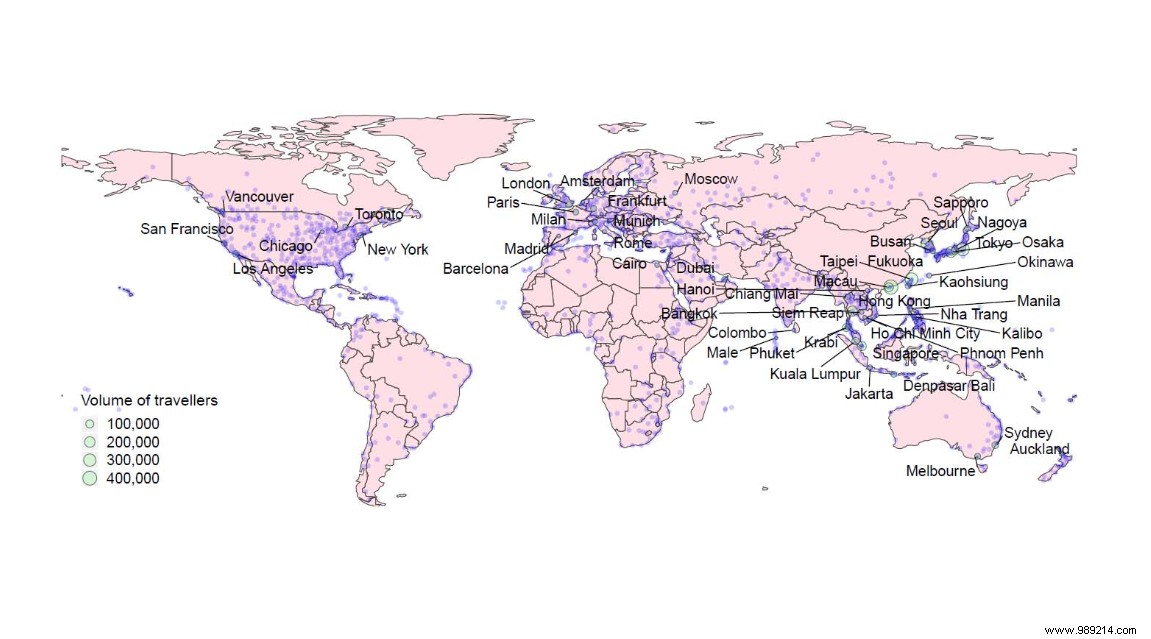
The top 10 includes Bangkok, Thailand (1st), Hong Kong (2nd), Taipei (3rd), Seoul (4th), Tokyo (5th), Singapore (6th), Phuket, Thailand (7th), Osaka (8th), Kuala Lumpur (9th), and Macau (10th).
The first non-Asian cities appear in Australia: Sydney (12th) and Melbourne (14th), followed by US hubs Los Angeles (15th) and New York (16th). Others include Dubai (17th), London (19th), Paris (27th), and Frankfurt (30th).
Source
Related Articles:
