Researchers at City University of Hong Kong have pioneered a biocompatible spray that converts millimeter-sized objects into controllable "robots." Guided by magnetic fields, these millirobots hold promise for targeted drug delivery and catheter insertion.
This innovative M-spray, developed by a team from City University of Hong Kong, transforms small objects into functional airship-like robots for biomedical use. Announced on November 19, 2020, the spray consists of polyvinyl alcohol (PVA), gluten, and iron particles, forming a thin coating of 0.1 to 0.25 mm thickness.
The spray adheres seamlessly to various medical tools without altering their shape or size. Objects are magnetized in one or more directions, then heated to solidify the coating.
Extensive testing revealed that these millirobots can be precisely guided by magnetic fields and exhibit multiple locomotion modes, such as crawling (cotton thread), rolling (pipe), or walking (origami). Locomotion can be reprogrammed by applying a strong magnetic field.
Once positioned, an oscillating magnetic field disintegrates the coating in just 8 minutes in acidic environments, allowing natural expulsion from the body. This can extend to 15 minutes with added PVA or 30 minutes using nickel instead of iron.
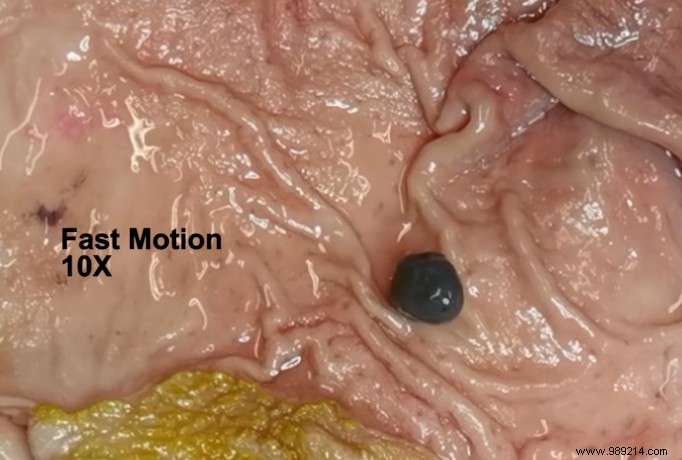
Potential uses include guiding catheter or sensor insertion and targeted drug delivery. In a successful rabbit stomach trial, researchers demonstrated precise medication administration.
This advances prior work, like the University of Exeter's 2018 sperm-like magnetic microdrones for drug administration.
Watch the project video below:
