From processing daily experiences to preparing for a big presentation, many rely on self-talk to organize thoughts effectively. Researchers have spent years exploring this inner dialogue, its benefits, underlying mechanisms, and even its absence in 2-5% of people—a condition called aphantasia.
For decades, scientists assumed an inner voice was universal to human cognition. However, not everyone navigates life through verbal self-dialogue. "By interior monologue, we mean a private discourse addressed to ourselves without articulation or sound," explains Hélène Lœvenbruck, PhD, principal researcher in psychology and neurocognition, and head of the language team at CNRS.
With vivid self-talk, you can almost "hear" your inner voice, complete with tone and intonation—perhaps sounding anxious or motivational. Studies show children as young as 5-7 use an inner voice, with some evidence of rudimentary inner phonetics emerging by 18-21 months.
Lœvenbruck's team analyzed self-talk across three key dimensions in a 2019 Frontiers in Psychology study. The first is dialogue: Inner speech can range from simple monologue to complex dialogue, debating multiple perspectives.
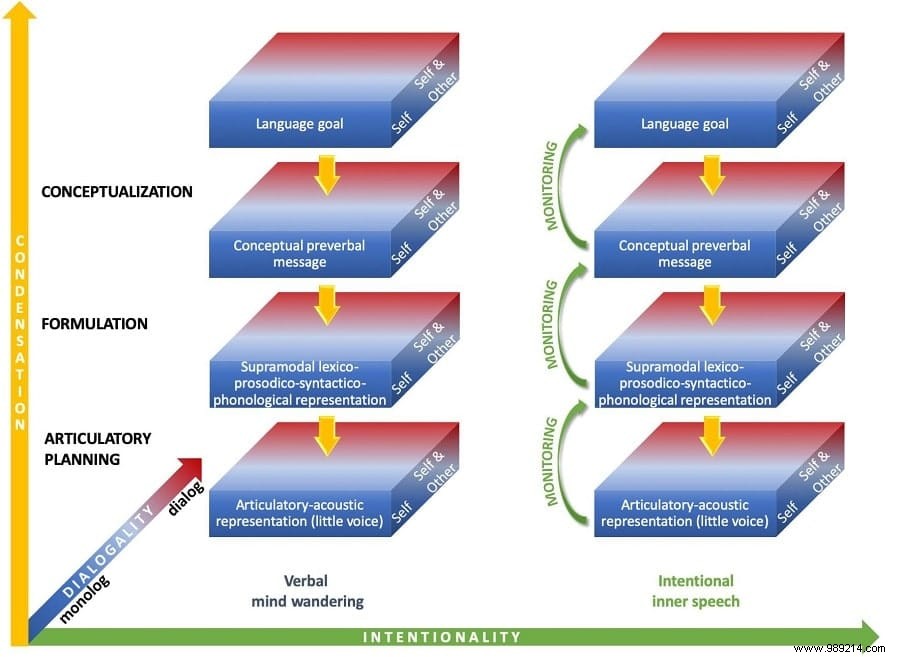
A basic monologue might be, "I need to buy bread." In contrast, reasoning often unfolds like a conversation. The second dimension, condensation, assesses verbosity: Thoughts can be fragmented words or full, elaborate sentences, especially during speech prep.
The third, intentionality, evaluates control. Self-talk can be deliberate or drift randomly. A historical challenge in research? Participants often verbalized non-verbal thoughts, skewing results.
This assumption of universality was upended in the late 1990s by Russell Hurlburt, PhD, psychologist at the University of Nevada. Aphantasia means lacking mental imagery—no visualizing a room or loved one's face—and often no inner voice.
Neither condition is inherently negative. Yet, understanding diverse thought processes, per Lœvenbruck, holds promise for education and learning strategies. Children's varied inner experiences may have been overlooked, impacting how we teach effectively.
