
Wondering if someone is lying to you? While we can't rely on a polygraph, experts in non-verbal communication highlight reliable cues from body language to help discern truth from deception.
These techniques, grounded in behavioral psychology, focus on subtle gestures and patterns. Here's a straightforward guide to detecting lies.
Refer to the legend in the top right image to decode common gestures:
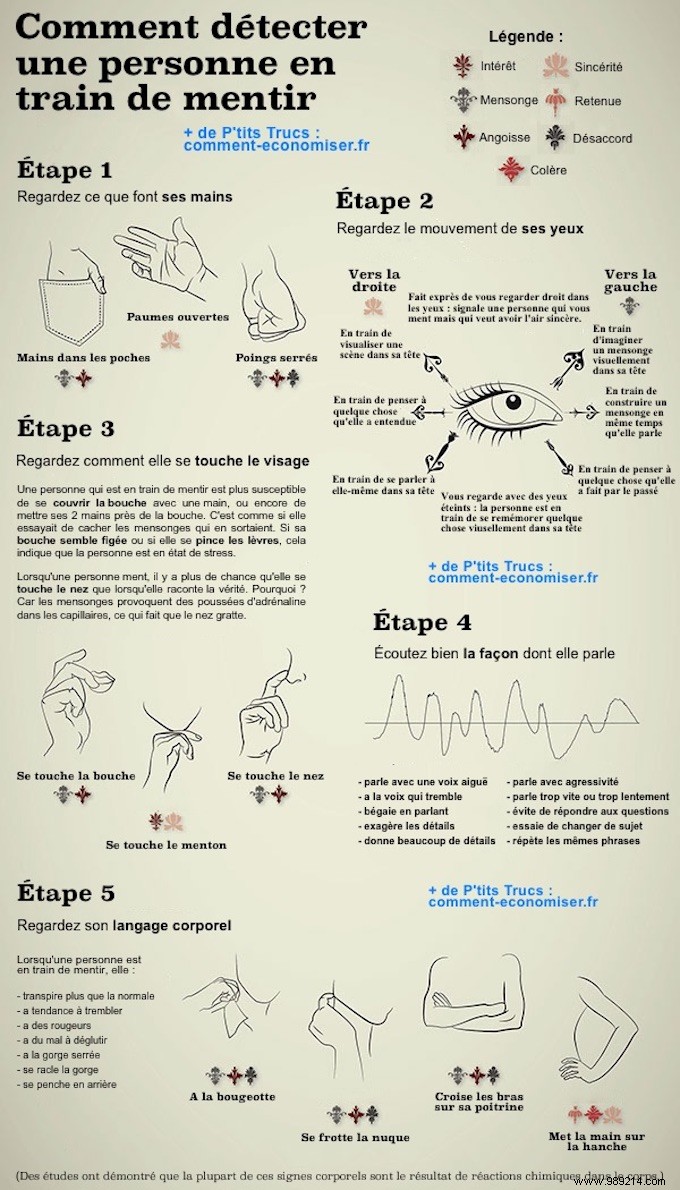
- Hands in pockets = lie, anguish
- Open palms = sincerity
- Clenched fists = lie, anguish, disagreement
If the person looks to the right = sincerity
- Top right: Visualizing a scene
- Far right: Recalling something heard
- Down right: Self-talk
If the person looks to the left = potential lie
- Top left: Constructing a visual lie
- Far left: Building a lie from sounds
- Bottom left: Recalling past actions
If the person stares you straight in the eye
- Intentional eye contact to appear sincere while possibly lying
- Dim or unfocused eyes: Recalling visuals
A liar often covers their mouth or brings hands near it, as if blocking words. Frozen mouth or pursed lips signal stress.
They may touch their nose more due to adrenaline-induced itching from dilated capillaries.
- Touching mouth = lie, anguish
- Light chin touch = interest, sincerity
- Nose touch = lie, anxiety
- High-pitched voice
- Trembling voice
- Stuttering
- Exaggerated details
- Excessive details
- Aggressive tone
- Too fast or too slow speech
- Avoids questions
- Changes subject
- Repeats phrases
- Fidgeting = lie, anxiety, disagreement
- Rubbing neck = lie, anguish, disagreement
- Arms crossed over chest = lie, anguish, disagreement
- Hand on hip = restraint, anger, sincerity
When lying, people often:
- Sweat excessively
- Tremble
- Flush red
- Struggle to swallow
- Tight throat
- Clear throat frequently
- Lean away
Armed with these insights from behavioral studies, you can better identify manipulators or habitual liars—works for men and women alike, thanks to universal stress responses.
