 In areas where we'd rather not catch up to men—let alone surpass them—cancer stands out. According to Public Health France's latest report, 1 in 6 women will develop cancer in her lifetime. The empowering question: What if we took proactive control?
First, the figures: In 2018, France saw 382,000 new cancer cases—372,600 in men and 177,400 in women. While overall cancer incidence remains stable in men (+0.1% per year), it is increasing in women (+1.1% per year).
Why the rise?
"This stems from changes in women's lifestyles," explains Dr. Hanene Boudabous, oncologist at Hartmann Clinic. Once more cautious than men through the 1970s and 1980s, women have increased smoking and drinking since then. Today's over-50 generation is bearing the consequences.
Breast cancer remains the most common and deadliest (59,000 new cases annually, over 12,000 deaths). Yet the most alarming surge—5% yearly increase—is in lung cancer, largely linked to tobacco. While smoking rates drop among men aged 18-24, they hold steady for young women, per Public Health France. Notably, women often develop equivalent nicotine dependence despite fewer cigarettes.
Prevention campaigns offer real hope. After two decades of breast cancer awareness and screening efforts, mortality has declined (-1.3% per year). Cervical cancer mortality has dropped over 2% annually, though women aged 50-60 lag due to lower screening rates.
Lifestyle plays a major role in many cancers: 20% tied to tobacco, 8% to alcohol, 5% to overweight, 3% to UV exposure, and 2% to papillomavirus. Environmental factors (pollution, endocrine disruptors, diesel particles) account for 5-10%; occupational risks (night shifts, ionizing radiation) add more. The health crisis delayed diagnoses, exacerbating issues.
Reversing trends demands stronger prevention and education. A recent AÉSIO Mutual and Harris Interactive survey1 on Women's Health reveals gaps: Only 59% of women know breast cancer risk factors, 66% for lung cancer, and fewer than half recognize colorectal cancer triggers from behaviors or environment. Most know the '5 fruits and vegetables a day' rule to cut risk, but just 35% follow it. Physically, 34% get under one hour of activity weekly. Positively, women's alcohol intake averages under 5 drinks weekly—half the recommended maximum.
Progress is happening. Let's build on it and reclaim our health—it's invaluable.
1 AÉSIO Mutual and Harris Interactive survey, Women's Health. May 2021
"Listen to your body and heed health messages," urges Dr. Laure Panel, surgeon-gynecologist at Mutual Clinic Beau Soleil - AÉSIO Santé2 in Montpellier. Your GP is key, but consult gynecologists, midwives, family planning, or PMI centers too.
2 AÉSIO Santé is a mutual network of healthcare establishments
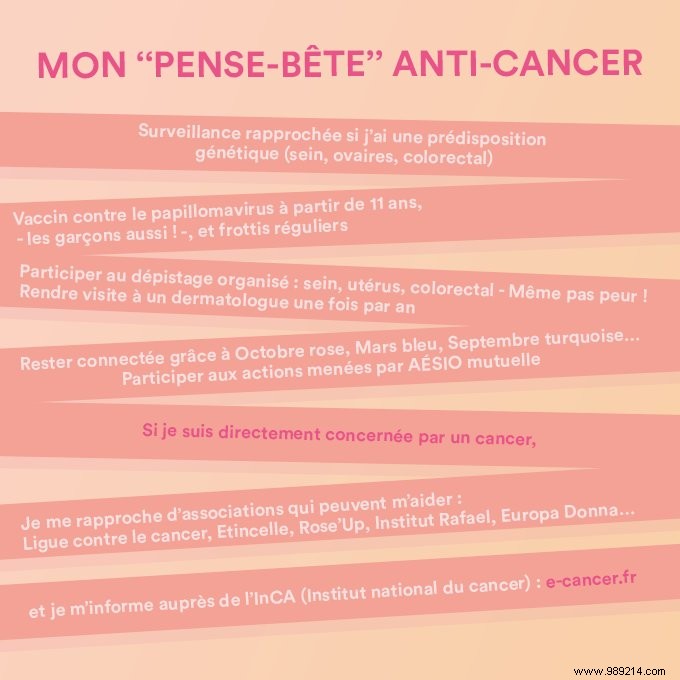
More on #WOMEN'SHEALTH
> Follow AÉSIO Mutual on social networks:
